The Marketing Myth of "Natural Daylight" Bulbs
Walk down the electrical aisle of any hardware store, and you will see boxes boldly labeled "Natural Daylight" featuring ratings between 5000K and 6500K. To the uninformed buyer, "natural daylight" sounds intrinsically healthy, vibrant, and superior to "old-fashioned yellow light." This is one of the most misleading marketing concepts in the consumer lighting industry.
Real daylight is not a static 5000K bulb. Real outdoor daylight is dynamic: shifting from 2000K at dawn, peaking near 5500K under direct noon sun, reaching 7500K under an overcast sky, and descending back to 2200K at sunset. Most importantly, solar illumination outdoors delivers 10,000 to 100,000 lux of full-spectrum light. Installing an artificial 5000K LED bulb that delivers a meager 300 lux inside an enclosed room produces an unnerving, bluish-gray visual environment that feels like an interrogation room or commercial parking garage.
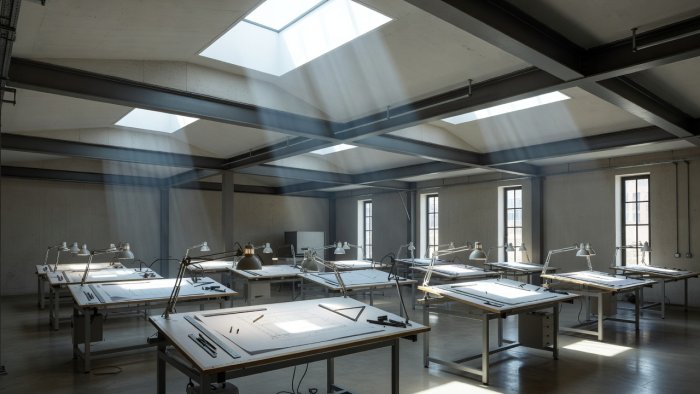
Where 5000K Genuinely Belongs
While ill-suited for relaxation or dining, high-Kelvin illumination has legitimate, high-value uses in specialized home spaces:
- Fine Art Studios & Oil Painting: Pigment balancing requires unbiased spectral illumination that avoids warm casts, ensuring gallery-ready color accuracy.
- Woodworking & Precision Machinery: Detecting micro-tolerances on turning lathes, joinery seams, and mechanical assemblies benefits from the high edge contrast of 5000K.
- Indoor Botany & Seed Propagation: Vegetative growth stages absorb 450 nm blue spectrum heavily to drive robust chlorophyll synthesis without stretching.
- Early Morning Circadian Light Therapy: Timed exposure to high-lux 5000K light during the first 45 minutes of the morning helps reset circadian phase delay in shift workers.
The Circadian Hazard of Post-Sunset Daylight Bulbs
The human retinal protein melanopsin features peak sensitivity at approximately 480 nm. When exposed to 5000K illumination at 9:00 PM, melanopsin signals the pineal gland that it is midday on the equator. As a result, natural melatonin synthesis drops sharply. Sleep architecture is disrupted, deep slow-wave restorative sleep is delayed, and waking cortisol patterns become irregular.
Unless an area is strictly walled off for daytime shift work or nighttime emergency utility, 5000K bulbs should never be tied to common household lighting circuits. If a garage or workshop requires 5000K, keep it physically and visually sealed from residential living spaces.
| Characteristic | Warm White (2700K) | Cool Task (4000K) | Daylight (5000K - 6500K) |
|---|---|---|---|
| Dominant Spectrum | Long wave (Red/Amber) | Balanced (Green/Yellow) | Short wave (Cyan/Blue) |
| Circadian Action | Relaxing / Melatonin Safe | Neutral / Mildly Alerting | Strong Melatonin Suppression |
| Texture Appearance | Deepens warm wood & brick | True neutral architectural | Flattens warmth, sharpens steel |
| Recommended Use | Lounges, Dens, Bedrooms | Kitchens, Vanities, Offices | Workshops, Art Studios only |
Containment Architecture for High-Kelvin Workspaces
If you run a high-focus studio or home workshop at 5000K, spatial containment is essential. High-Kelvin light reflects through open doorways and creates an unappealing blue halo on the warm walls of adjacent hallways. Use solid partition doors, adjust fixtures with glare cut-off louvers, and avoid shining high-Kelvin beams near windows that face neighboring bedrooms or outdoor seating patios.