The Demands of Culinary Visual Acuity
A kitchen is fundamentally an operational workshop disguised as a domestic gathering space. Sharp knives, high heat, hot oils, and biological raw foods interact on cutting boards and cooktops. Attempting to chop garlic or inspect the searing of beef under 2700K warm ambient light presents distinct optical hazards. Warm light reduces contrast between organic hues, casts soft shadows that obscure blade edges, and conceals microscopic grease films on stainless steel surfaces.
By transitioning the task plane to 3500K or 4000K, contrast sensitivity increases significantly. The human eye identifies small visual details with less strain. Edges of meat cuts, subtle discolorations on leafy greens, and the precise boundary of a chef's knife edge become immediately discernible without requiring excessive raw wattage.
Why 3500K Over Harsh 5000K
Homeowners seeking better clarity often make the mistake of overcorrecting: they buy 5000K or 6500K "commercial" bulbs. While 5000K provides ample blue contrast, in a domestic kitchen it creates intense visual harshness. Highly polished quartz, polished porcelain tiles, and stainless steel appliances produce sharp glare hotspots that tire the eyes. Furthermore, 5000K makes warm wood cabinetry and toasted food appear dull and cold.
The sweet spot for contemporary culinary lighting is exactly 3500K. Known among architectural lighting designers as "transitional neutral," 3500K delivers the clarity of white light without the clinical chill of pure daylight. Under 3500K, fresh herbs look crisp green, bread bakes to an authentic golden brown, and marble veining displays sharp definition.
Resolving the Kitchen-Dining Conflict
In modern open-concept floorplans, the kitchen island sits directly adjacent to dining and entertaining zones. If you install unshielded 3500K ceiling cans across the entire expanse, dinner guests are bombarded by bright, clinical task light. To resolve this architectural dilemma, follow three essential separation rules:
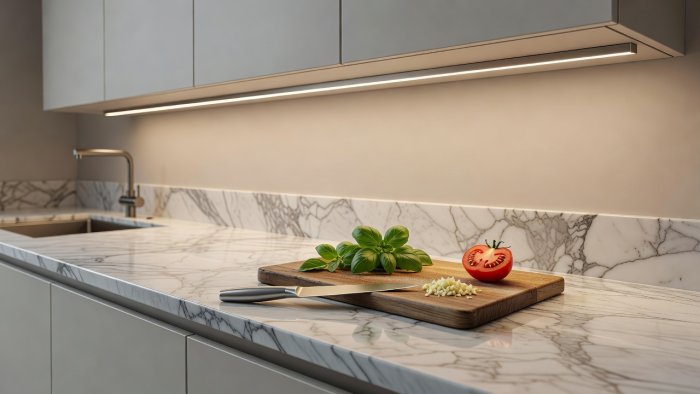
- Shield the Light Source: Confine 3500K task lighting exclusively to deep recessed fixtures with 40-degree cut-off angles or high-density under-cabinet strips. Light should strike the countertop directly, keeping the bare LED diode hidden from seated dinner guests.
- Separate Electrical Switching: Never wire under-cabinet prep lighting and dining island pendants to the same dimmer circuit. Run the task plane at 3500K during meal preparation, then switch it off entirely during dining.
- Warm Island Pendants (2700K): Hang decorative low-glare pendants over the island on an independent circuit at 2700K. Once food preparation is complete, turn off the 3500K prep downlights and illuminate the warm pendants to transform the island into an intimate social gathering hub.
| Kitchen Zone | Kelvin Target | Fixture Type | Control Protocol |
|---|---|---|---|
| Prep Countertops | 3500K (CRI 95) | Concealed Under-cabinet linear LED | Independent on/off toggle |
| Range & Cooktop Hood | 3500K – 4000K | Vapor-sealed flush pucks | High-output task switch |
| Island Dining Pendants | 2400K – 2700K | Diffused glass or fabric shade | Dedicated phase dimmer |
| Circulation Perimeter | 3000K | Baffle downlights or cove uplight | Integrated ambient circuit |
Bathroom Mirror Clarity: The 3500K–4000K Vanity Standard
This exact same principle applies to primary bathroom vanities. Shaving, makeup application, and skincare analysis require truthful color rendering. A 2700K bulb in a bathroom casts an artificial yellow cast over the skin, masking redness and blemishes. Conversely, a 5000K bulb highlights skin imperfections too starkly, leading to over-application of cosmetics. Cross-illuminating the face from both sides of the mirror with 3500K to 4000K fixtures (at 95+ CRI) provides true, natural daylight-ready reflection.